ENTER, founded in 2021, is an international network organization dedicated to enhancing the professional competence of tertiary-level educators through a globally recognized registration and certification process, granting the prestigious status of iPER (International Professional Educator Registered).
ENTER coordinates the International Register of Professional Educators and supports higher education institutions in identifying faculty development needs and fostering continuous growth through high-quality, accredited professional development opportunities. In addition, ENTER contributes to institutional quality enhancement by supporting and promoting international accreditation of both study programs and professional development programs, based on robust quality assurance standards and peer-review mechanisms.
Through its membership and cooperation agreements with leading professional associations and networks, ENTER actively supports universities in quality assurance processes—particularly in the international accreditation of study programs—and plays an active role in initiating and participating in international projects and partnerships with institutions across Europe, Asia, Africa, and Latin America.
The ENTER Network’s main purpose is to provide an international individual registration procedure to assess and certify the level of professional competence of tertiary-level educators. When the achieved level of an educator’s professional competences corresponds to criteria aligned with international best practices, the procedure regulates the registration of the educator and issues an international professional card, enabling broader recognition of educators’ qualifications worldwide.
ENTER coordinates all elements necessary to develop and maintain an International Professional Educator Register that strengthens transparency and empowers higher education institutions to consider certified educators from different countries for high-profile faculty positions. At the same time, the registration process motivates educators to continuously improve their skills and competencies.
Finally, the ENTER Network enforces rigorous, peer-reviewed quality control through ENTER quality assurance standards, supporting the accreditation and continuous improvement of study programmes and professional development programmes in line with internationally recognized practices.
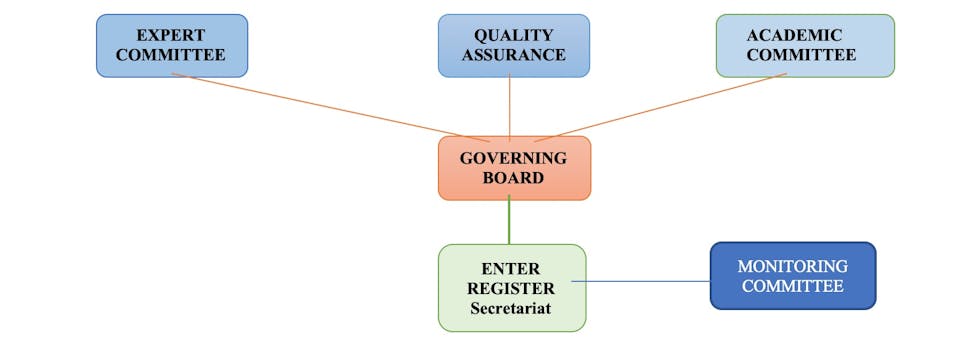
The ENTER Network is composed by the following Committees:
i. Governing Board
ii. Academic Committee
iii. Quality Assurance Committee
iv. Expert Committee
v. Monitoring Committee
The ENTER Network has also the ENTER Register Secretariat
All the above described internal bodies are interrelated accordingly with the following diagram: